
You Are Not Just a Body in Poses
Yoga Is More Than What You Can See
If you've been practicing yoga for any length of time, you've probably noticed something that's hard to name. The class ends, you roll up your mat, and something has shifted — not just in your hamstrings or your shoulders, but somewhere deeper. You feel quieter. More spacious. More like yourself.
That's not an accident. And it's not just endorphins.
Yoga has always known that the human being is not simply a physical body performing shapes. The tradition offers two interwoven frameworks for understanding what you actually are — and together, they explain why this practice reaches places that stretching never could.
The poses are the door. But you are the whole house.
The Three Bodies: A Map of Your Layers
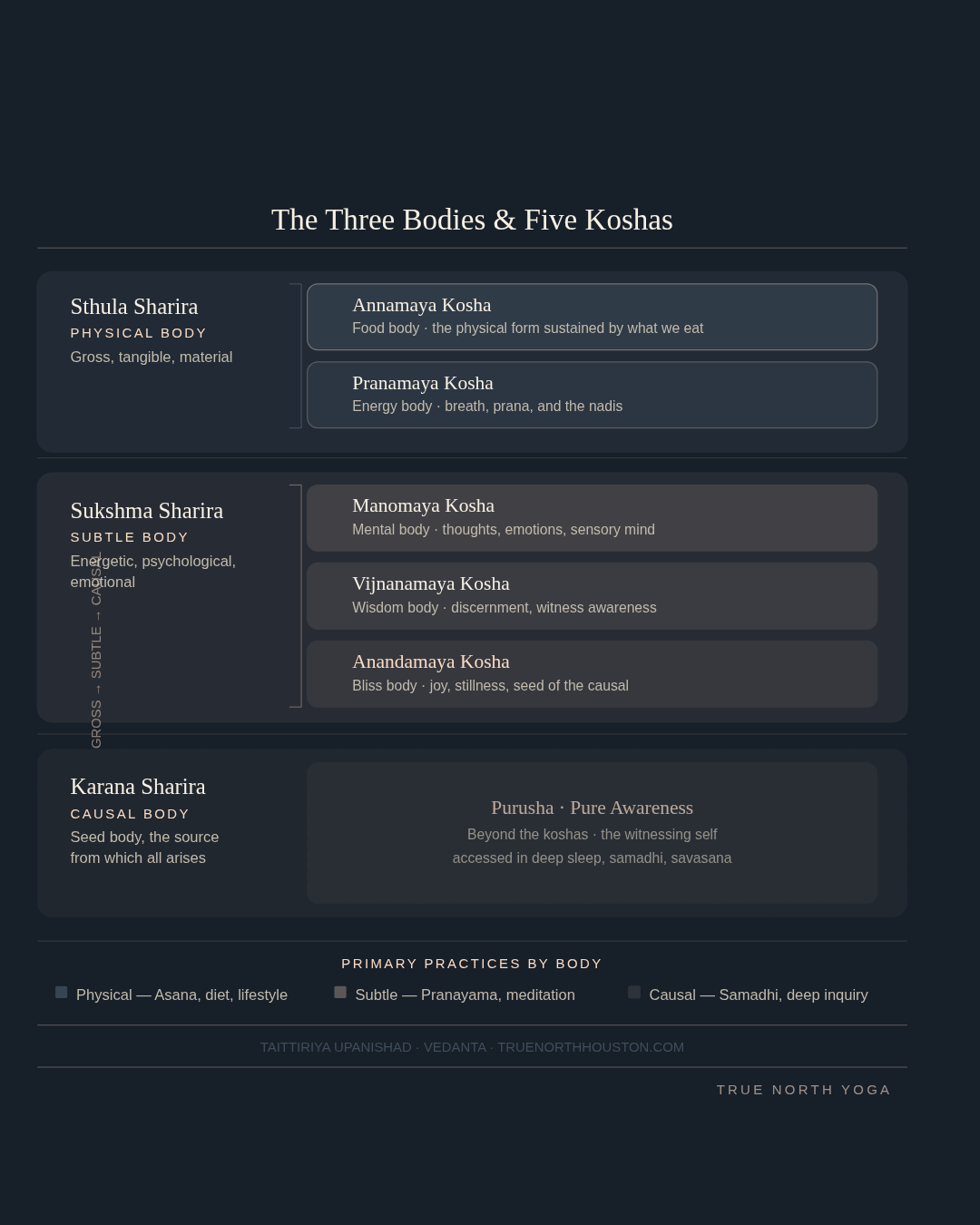
Vedantic philosophy describes the human being as existing across three distinct bodies simultaneously. Not three separate selves — three layers of the same self, each operating at a different level of density and awareness.
🔥 The Physical Body (Sthula Sharira)
This is the body you can see and touch. Bone, muscle, organ, breath. It's what most people think of when they say "I did yoga today." The asana practice lives primarily here — building strength, improving mobility, training the nervous system, and creating the conditions for deeper practice. It matters enormously. But it's the outermost layer.
⚡ The Subtle Body (Sukshma Sharira)
Beneath the physical is the subtle body — the energetic and psychological dimension of your experience. This is where prana (life force) moves through channels called nadis, where emotion lives before it becomes thought, and where the breath connects the voluntary and involuntary aspects of the self. When pranayama clears your mind in ways that thinking about clearing your mind never does, you're working in the subtle body. This is also where the five koshas — the layers we'll explore below — are most directly accessible.
🌌 The Causal Body (Karana Sharira)
The deepest layer is the causal body — the seed body, the source from which the other two arise. This is the dimension addressed by meditation, deep sleep, and the most advanced practices of the tradition. It's where the individual self rests in something larger. Most of us brush it only in savasana, in moments of stillness so complete that the ordinary sense of "me" temporarily dissolves.
The Five Koshas: A More Detailed Map
Within these three bodies, the Taittiriya Upanishad offers an even more precise map: five koshas, or sheaths, nested within each other like Russian dolls — each one subtler than the last, each one bringing you closer to your essential nature.
The word kosha means sheath or covering. The teaching is that what we truly are is not any of these layers — but that we can only discover that truth by moving through them with awareness.
🏃 Annamaya Kosha — The Food Body
The outermost sheath is the physical body — literally the body made of food (anna = food). This is where asana practice does its most visible work: building strength, opening tension, creating space for the breath. Most people spend their entire yoga lives here. There's nothing wrong with that. It's a profound layer. But it is the beginning, not the end.
🌬️ Pranamaya Kosha — The Energy Body
Just beneath the physical is the sheath of prana — the life force that animates the body and connects it to the breath. This is why pranayama is not optional in classical yoga: it's the primary technology for working directly with the energy body. When your breath changes, everything changes. The nervous system shifts. Thought patterns shift. The emotional quality of your experience shifts. You've moved into the second sheath.
🧠 Manomaya Kosha — The Mental Body
The third sheath is the layer of mind — thoughts, emotions, memories, and sensory perception. This is the layer that narrates your yoga practice ("my hips are so tight," "I'm not good at this," "I need to remember to breathe") and the layer that yoga is quietly, persistently trying to quiet. Every instruction to "let go," to "stay present," to "soften your grip" is an invitation to work with the mental sheath. This is also where most psychological suffering lives.
💡 Vijnanamaya Kosha — The Wisdom Body
Deeper still is the sheath of discernment and intelligence — the aspect of awareness that can observe the mental body rather than being swept along by it. In the yoga tradition, this is sometimes called the witness. Meditation is its primary practice. When you find yourself watching your thoughts in savasana rather than being your thoughts, you've touched vijnanamaya kosha. This is the layer that develops genuine self-knowledge.
✨ Anandamaya Kosha — The Bliss Body
The innermost sheath — and the most subtle — is the body of bliss (ananda = bliss, joy, fullness). This is not happiness in the ordinary sense. It's the natural quality of awareness when all the other layers are temporarily quiet. You may have felt it: a moment in practice when effort dissolved into ease, when you were completely present, when something that usually feels like "you" just... rested. That's the fifth kosha. It's the closest the tradition can get to pointing at your essential nature in language.
Why This Matters for Your Practice
Understanding the koshas doesn't change what you do on your mat. You still flow, still breathe, still hold warrior two until your thighs disagree with your intentions.
But it changes how you inhabit what you do.
When you're in a challenging pose, you're not just managing your body — you're simultaneously working with prana, with the stories your mind tells, with your capacity to observe yourself without judgment. When you breathe slowly at the beginning of class, you're not just calming down — you're shifting the quality of your experience at every layer.
And when you rest in savasana, you're not wasting time. You're doing some of the most sophisticated work the tradition offers.
The poses are the vehicle. The destination is the whole of you.
The Practice Is Deeper Than It Looks
This is what makes yoga different from stretching, different from exercise, different from stress management — even when it does all of those things beautifully.
The physical body is the place we begin because it's the most accessible layer. You can feel a hamstring. You can count your breath. You can notice when your shoulders are around your ears. The gross, visible, touchable body is the doorway.
But yoga has always understood that the doorway is not the house. Every breath you take in this practice is moving prana. Every time you bring your wandering attention back to the present moment, you're building a relationship with the witness. Every savasana is a brief, honest encounter with something quieter than thought.
You are not just a body in poses.
You are a being of extraordinary depth, practicing in a tradition that has mapped that depth for thousands of years.
The poses are an invitation to explore. The whole point is to keep going.
Want to go deeper? The True North RYS 200 Teacher Training explores the koshas, prana vayus, and the full philosophical framework of yoga in detail. Learn more at truenorthhouston.com.
